Policy and process explainer
MECCA complaints and whistleblower policy: what the public sources say
People searching for MECCA's complaints process may be looking for more than one pathway. The company's public sources distinguish personal workplace grievances, bullying and harassment complaints, and protected whistleblower disclosures.
Keep the source categories separate
The material on this page does not all have the same evidentiary role. Company policies describe stated procedures. Public reviews and first-hand accounts describe individual experiences. Inside MECCA analysis identifies what can be compared and which questions remain unanswered.
Verified public company policy
MECCA's whistleblower policy is published on the company's website. The page states that it was last amended in February 2022. This article was checked against the live page on 12 August 2026.
Publicly hosted company policy
A Discrimination, Bullying & Harassment Policy is publicly available through MECCA's Stopline site. The PDF states an effective date of December 2015. Its current internal status has not been independently confirmed.
Public employee reviews
Reviews may describe what individual people say they experienced, but they are not used here to establish what MECCA's formal complaint process was or how it operated in any particular case.
Submissions to Inside MECCA
Private submissions are not used on this page. A separately published case study remains first-hand testimony with its own consent, evidence status and limitations.
Inside MECCA analysis
This page compares what the public policies say, identifies distinctions between pathways and records what the documents cannot establish about practice.
The public sources describe more than one reporting pathway
MECCA's public whistleblower policy says statutory protection depends on who makes the disclosure, what is disclosed and who receives it. It distinguishes a protected disclosure from a personal work-related grievance. The policy says personal grievances should generally be raised with a manager, a Human Resources manager or another MECCA leader the employee feels comfortable approaching.
The same policy says some personal grievances can overlap with a disclosable matter in limited circumstances, including where the disclosure indicates misconduct beyond the individual's circumstances or where detrimental treatment follows a disclosure. The legal classification depends on the facts. This page cannot determine which pathway applies to an individual.
The separate bullying and harassment policy describes manager and Talent and Culture responsibilities, informal and formal intervention, record keeping, investigation steps and possible outcomes. Because the PDF is dated December 2015, it should not be assumed to be the current internal procedure without confirmation.
What the public whistleblower policy says
- Eligibility matters.The policy links statutory protection to an eligible whistleblower, an eligible recipient and a disclosable matter.
- Anonymous reporting is contemplated.The policy says a person may report anonymously, while noting that an investigation can only work with the information available.
- An external channel is listed.The policy identifies Stopline as an independent and confidential reporting service that acts as an intermediary between the reporter and MECCA.
- Assessment is not the same as a formal investigation.The policy says reports are assessed and a decision is made about whether and how they should be investigated.
- Confidentiality affects feedback.The policy says feedback may be provided where appropriate, subject to confidentiality and other constraints.
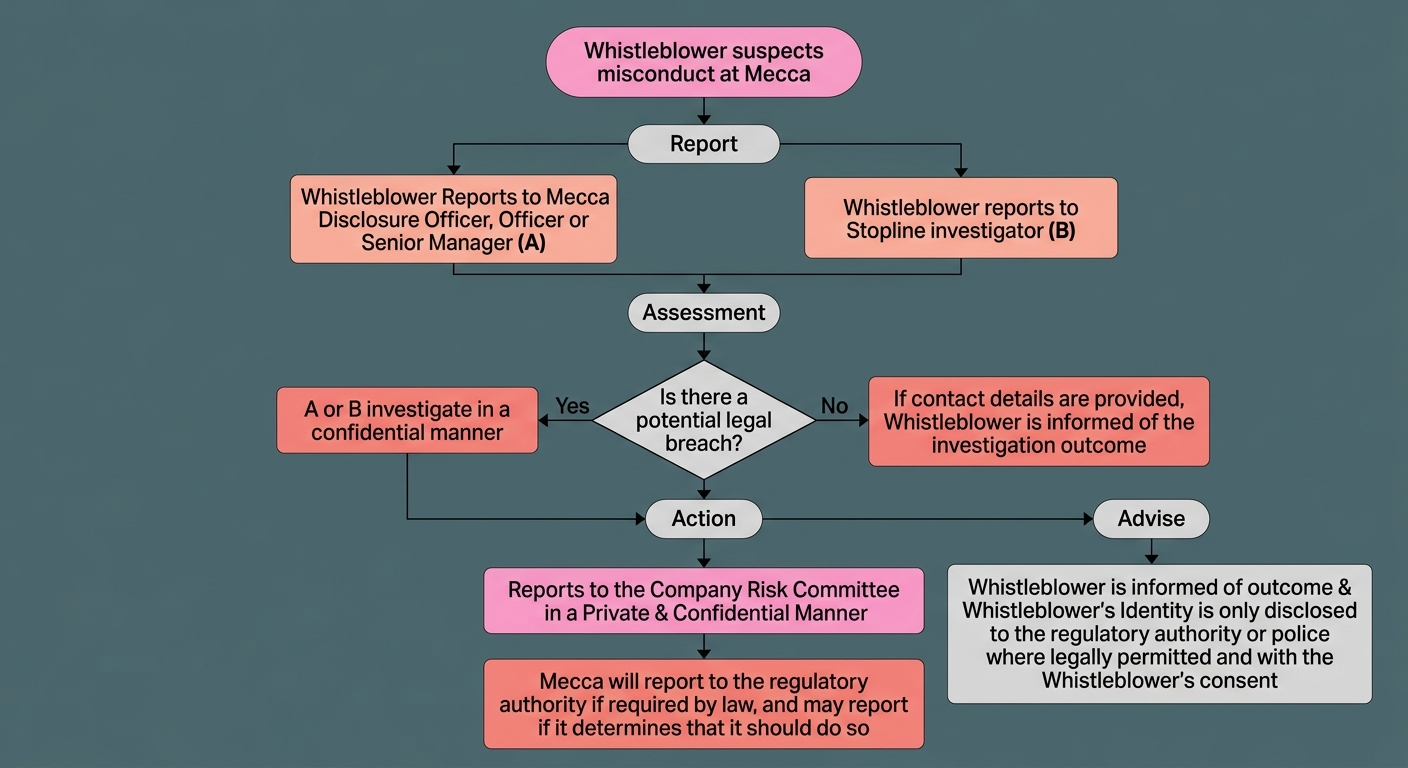
MECCA whistleblower reporting and assessment flowchart. Source: MECCA's publicly available whistleblower-policy material. Reproduced for criticism, review and public-interest analysis. The available reproduction is cropped at the lower edge.
This diagram describes MECCA's stated reporting and investigation process. It does not establish how any individual report was handled in practice.
▶ Read the flowchart as text
Text summary of the flowchart (description of the visible diagram):
- A whistleblower suspects misconduct at MECCA.
- The report can be made to a MECCA disclosure contact, officer or senior manager, identified in the diagram as pathway A.
- The report can alternatively be made to a Stopline investigator, identified as pathway B.
- The matter is assessed to determine whether there may be a potential legal breach.
- If a potential legal breach is identified, pathway A or B investigates the matter confidentially.
- The diagram then moves to an action stage.
- It shows reporting to the Company Risk Committee in a private and confidential manner.
- It refers to reporting to a regulatory authority where required by law and potentially in other circumstances determined by MECCA.
- Where contact details are provided, the diagram says the whistleblower is informed of the investigation outcome.
- It also says the whistleblower is informed of the outcome and that their identity is disclosed to a regulatory authority or police only where legally permitted and with the whistleblower’s consent.
Contact names, recipients and reporting details can change. Open the current company policy directly before relying on a reporting channel.
What the public bullying and harassment policy says
The publicly hosted PDF describes a staged resolution process. It says a person may raise conduct directly if they feel comfortable, then approach a manager, another manager or Talent and Culture. It also describes written escalation, informal intervention and a formal process involving interviews, records and relevant evidence.
The document says complaints should be taken seriously and confidentially, and that action may follow depending on the evidence and outcome. Those are policy statements. This page does not establish whether the process operated that way in a particular workplace, period or case.
Historical connection to the 2019 response
MECCA announced an external culture review, Stopline and expanded reporting arrangements during its response to the 2019 workplace controversy.
The public Whistleblower Policy page identifies February 2022 as its last amendment date. The available sources do not establish that the culture review caused that amendment, that Stopline was first introduced through the 2022 policy, or that the review's recommendations were incorporated into later procedures.
Questions the public documents cannot answer on their own
- Which policy version applied to a particular employee, workplace and date?
- Whether employees knew about and could access the relevant pathway.
- How quickly a particular report was acknowledged, assessed or investigated.
- Whether records were complete and whether affected people had a fair opportunity to respond.
- What outcome was reached and what could lawfully be communicated to the parties.
- Whether anyone experienced detrimental treatment after speaking up.
Answering those questions requires case-specific records, first-hand evidence, responses from relevant parties and current legal context. A policy alone is not enough.
Public sources
- MECCA Whistleblower PolicyOfficial company webpage. The page states that the policy was last amended in February 2022.
- MECCA Discrimination, Bullying & Harassment PolicyPublic PDF hosted on MECCA's Stopline site. The document states an effective date of December 2015; current status is not independently confirmed.
Related Inside MECCA material
Important
This is research context, not legal advice or a reporting service
Inside MECCA is not MECCA's whistleblower hotline, a regulator, an employee representative body or a law firm. If you need to rely on legal protections or decide where to report, obtain independent advice about your circumstances and check the current official pathway.